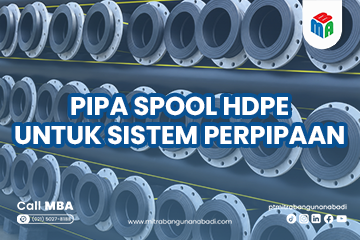
HDPE Spool Pipe for Piping System
HDPE Pipe Spool: Types, Butt Fusion Technique, and Industrial Applications

HDPE pipe spool systems have become one of the most efficient solutions for industrial and mining pipeline installations. By using workshop-based fabrication and butt fusion welding methods, HDPE pipe spools provide faster installation, higher precision, and improved joint reliability.
In industries such as mining operations in South Kalimantan, HDPE pipes are widely used due to their corrosion resistance, flexibility, and long-term durability under demanding operating conditions.
What Is an HDPE Pipe Spool?

An HDPE pipe spool is a pre-fabricated piping section assembled in a workshop or warehouse before being delivered to the project site for installation.
This system allows contractors to reduce field welding activities and accelerate installation processes.
Main components of an HDPE pipe spool include:
- HDPE pipe
- Stub end
- Steel backing ring or flange
Types of HDPE Pipe Spool
Single Flange Spool

A single flange spool has one flanged side and is commonly used when additional field connections are required.
Double Flange Spool

A double flange or all-flange spool comes with flanges on both ends, allowing direct installation between equipment such as pumps, valves, and manifolds.
This configuration significantly improves installation efficiency.
Butt Fusion Fabrication Process
HDPE pipe spool connections are made using the butt fusion welding method, which joins HDPE materials through heat and hydraulic pressure without adhesives.
1. Heating Process

The pipe ends and fittings are heated using an electric heater plate at approximately 200°C to 230°C.
2. Fusion Process

Once the material reaches the melting point, both ends are pressed together using hydraulic pressure to create a molecular bond.
3. Cooling Process

The joint is cooled under controlled pressure to ensure maximum joint integrity and long-term performance.
HDPE Joint Quality Control

Quality control is critical in HDPE spool fabrication.
One of the primary inspection indicators is the bead formed around the welded joint.
A consistent bead indicates:
- proper heat distribution,
- correct fusion pressure,
- and reliable welding quality.
Poor bead formation may lead to joint failure during pressure testing or operation
Mining Project Applications

Mining environments often involve unstable soil conditions and demanding operational loads. Pre-fabricated HDPE pipe spools help contractors improve installation speed while maintaining consistent quality standards.
Benefits include:
- reduced field welding,
- minimized installation errors,
- improved productivity,
- and better quality assurance.
Advantages of HDPE Pipe Spool Systems

HDPE pipe spool systems offer several advantages, including:
- corrosion resistance,
- flexibility,
- leak-free performance,
- faster installation,
- long service life,
- and lower maintenance costs.